


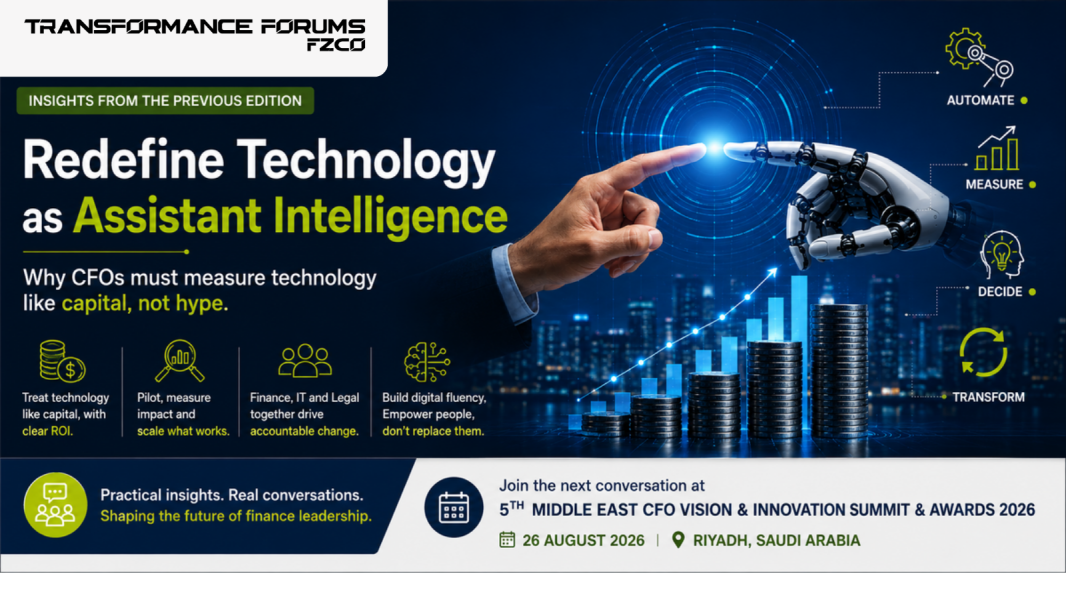
There is no shortage of conversations about AI in finance.
There is plenty of discussion about automation, new tools, faster reporting and what AI might change in the finance function.
But at the previous edition of the Middle East CFO Vision & Innovation Summit in Dubai , Sujay Sarkar took the discussion somewhere more practical.
His point was not about how impressive the technology is.
It was about what happens after you buy it, implement it and switch it on.
That is where the real test begins.

The Technology Is Not the Transformation
For finance leaders, technology investments are nothing new.
ERP systems, automation, analytics and now AI are all becoming part of the finance landscape. But a successful implementation does not automatically mean a successful transformation.
A system can go live on time.
A process can become automated.
A dashboard can look impressive.
And the business can still struggle to see the value.
“Transformation doesn’t fail because of technology, it fails because we stop measuring after launch.”
— Sujay Sarkar, Global CFO, Advanta Seeds (a UPL Group Company)
Sujay's message was a useful reminder:
“If you can’t measure it, you can’t manage it. And if you don’t manage it, you can’t transform it.”
— Sujay Sarkar
For the CFO, that means staying involved beyond the approval stage.
The question should not simply be whether the technology was implemented.
It should be whether the business is actually better because of it.
Rethinking AI as “Assistant Intelligence”
Sujay's description of AI as “Assistant Intelligence” offered another way to look at the conversation.
The idea is not that machines replace the finance professional.
It is that they take away some of the repetitive work so people can spend more time on the work that needs judgement.
Reconciliations can be automated.
Routine reporting can be streamlined.
Large volumes of data can be processed faster.
But someone still needs to ask:
What does this tell us?
What could happen next?
What are we missing?
What decision should we make?
That is where the finance professional becomes more valuable, not less.
What the Previous Edition Taught Us
The discussion around Assistant Intelligence pointed to a few practical lessons.
1. Measure the Outcome, Not the Excitement
AI can sound impressive on paper.
But the real measure is whether it improves something that matters to the business — accuracy, efficiency, forecasting, risk management, decision-making or time.
Technology should be measured by the business value it creates, not by how advanced or impressive it appears.
2. Keep Measuring After Implementation
The business case should not disappear once the project goes live.
If an automation project was expected to save time, measure the time saved.
If a forecasting tool was expected to improve accuracy, track the improvement.
If an AI investment was expected to support better decisions, look at whether those decisions actually improved.
Implementation is not the end of transformation. CFOs need to continue measuring whether the investment is delivering the value it promised.
3. Start With a Real Business Problem
The strongest technology investments are usually connected to a problem the business already understands.
Instead of asking:
“Where can we use AI?”
Ask:
“Where are we losing time, insight or accuracy today?”
That changes the conversation completely.
Start with the business challenge rather than the technology. The strongest investments solve a real problem that the organisation already understands.
4. Bring Finance Into the Transformation
Technology teams can build and implement systems.
But finance has an important role in understanding the business case, measuring the return and keeping the investment accountable.
Transformation works better when Finance, IT and other relevant functions are working together rather than handing the project from one department to another.
Finance should remain involved throughout the transformation journey — from the business case and investment decision through to measuring the results.
5. Give People Room to Use Their Judgement
Automation can handle more of the routine work.
That should create more space for people to think.
Scenario planning.
Forecasting.
Business partnering.
Risk assessment.
Strategic decisions.
The value of AI is not only what it can automate.
It is also what it allows people to focus on.
The real opportunity is not simply to automate more work. It is to give finance professionals more time to apply judgement, insight and strategic thinking.
The Question Worth Taking Forward
Perhaps the most useful insight from Sujay's session was a simple one:
“Don't measure transformation by what you installed. Measure it by what changed.”
That is an important distinction.
The finance function does not become more strategic simply because it has more technology.
It becomes more strategic when technology gives finance better information, more time and greater confidence to make decisions.
And that is where Assistant Intelligence becomes more than a different name for AI.
It becomes a different way of thinking about the relationship between people, technology and finance.