


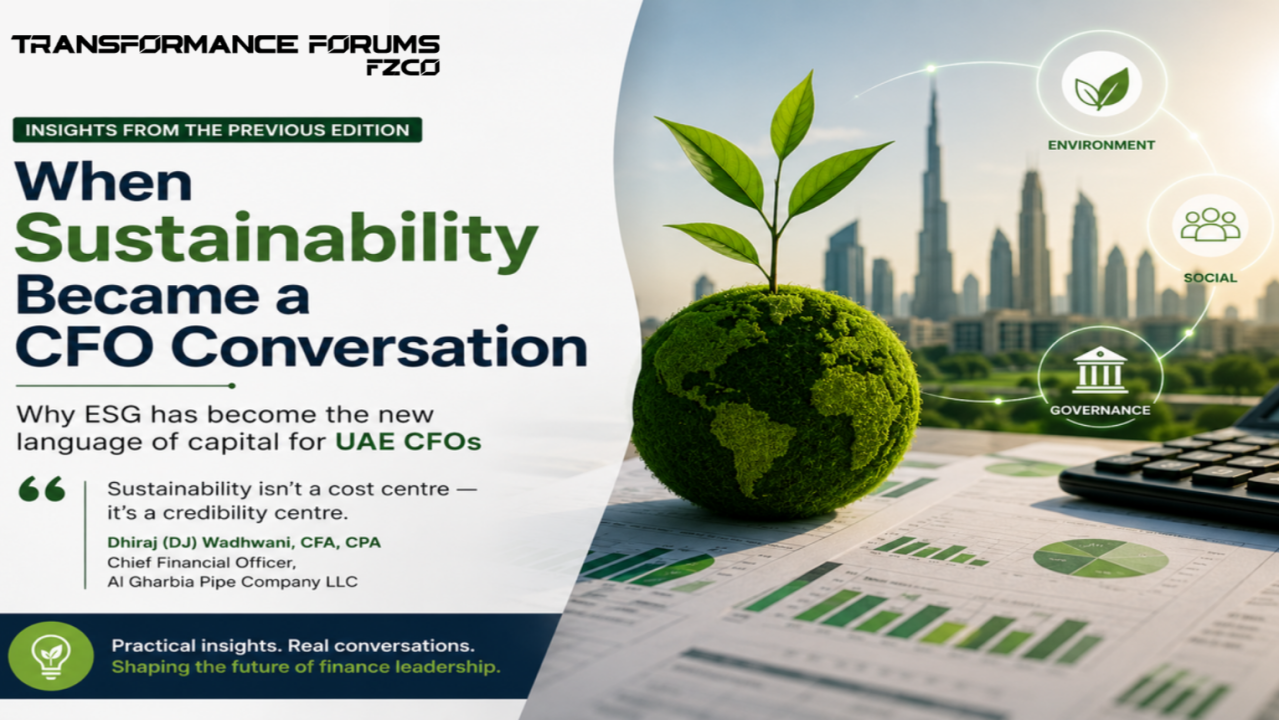
“Sustainability isn’t a cost centre, it’s a credibility centre.”

The role of sustainability in finance was one of the important conversations at the previous edition of the Middle East CFO Vision & Innovation Summit.
The discussion highlighted a shift that many finance leaders are now seeing in their organisations: sustainability is moving closer to financial strategy.
It is increasingly connected to capital, investment decisions, operating efficiency, stakeholder confidence and long-term business performance.
For CFOs, the question is no longer simply whether sustainability matters.
It is how to measure it, connect it to financial performance and make it part of everyday decision-making.
What We Heard in the Previous Edition
Dhiraj Wadhwani shared a perspective that captured this change:
“CFOs who embed ESG into their capital frameworks aren’t just meeting expectations, they’re attracting investors.”
— Dhiraj Wadhwani, CFA, CPA, Chief Financial Officer, Al Gharbia Pipe Company LLC
The insight was simple but important.
When ESG is treated separately from finance, it can remain a reporting exercise.
When it becomes part of financial planning and capital allocation, it becomes something the business can actually manage.
Sustainability needs to be measured with the same discipline as financial performance.
1. Sustainability on the CFO Dashboard
The discussion highlighted the need to look beyond traditional financial measures.
For example:
Profitability alongside energy efficiency and waste reduction.
Productivity alongside workforce wellbeing and safety.
Governance alongside accountability and transparency.
The point is not to replace financial KPIs.
It is to understand the wider factors that influence long-term business performance.
CFOs increasingly need a wider performance view, connecting traditional financial KPIs with the operational and sustainability factors that shape long-term value.
2. ESG & Capital Decisions Cannot Remain Separate
One of the key insights from the discussion was the importance of bringing ESG considerations into investment decisions.
For CFOs, this means asking:
What is the financial impact?
What risks are we reducing?
What efficiencies can we create?
What long-term value can this investment deliver?
When these questions become part of the capital allocation process, sustainability becomes part of the business strategy rather than a separate initiative.
ESG becomes more meaningful when it is included in investment and capital allocation decisions, rather than being managed as a separate initiative.
3. Measurement Changes the Conversation
If sustainability outcomes are not measured, they are difficult to manage.
The previous discussion highlighted the importance of putting numbers behind areas such as:
- Energy efficiency
- Waste reduction
- Carbon performance
- Workforce safety
- Operational efficiency
The broader insight was clear:
What gets measured gets discussed. What gets discussed gets acted upon.
Measurement creates visibility. Once sustainability outcomes become visible through data, they can become part of leadership conversations and decision-making.
4. The CFO Cannot Drive ESG Alone
Another important takeaway was that sustainability needs to involve the wider organisation.
Finance can help create the framework and measurement discipline, but procurement, operations, HR, technology and supply-chain teams all influence the outcome.
The CFO's role is increasingly about bringing these functions together around common objectives.
Finance can provide the framework and discipline, but meaningful ESG progress requires collaboration across the entire organisation.
5. Sustainability Is Becoming Part of Business Confidence
The previous edition also highlighted the connection between sustainability, transparency and stakeholder confidence.
For investors and other stakeholders, ESG performance can provide another view of how prepared an organisation is for the future.
That makes sustainability relevant not only to corporate responsibility teams, but also to the CFO, the board and investors.
Sustainability is increasingly becoming part of business confidence, giving investors and stakeholders another perspective on how prepared an organisation is for the future.
The Insight We Take Forward
The previous edition's discussion left finance leaders with an important consideration:
Sustainability should not sit on the side of financial strategy. It should be part of it.
As the CFO role continues to expand, understanding the financial impact of sustainability will become increasingly important.
And this is where the conversation continues.
Looking Ahead
The insights from the previous edition continue to shape the conversation around finance leadership, sustainability and long-term value creation across the Middle East.
These conversations will continue as finance leaders come together at the 5th Middle East CFO Vision & Innovation Summit & Awards 2026 .
Sustainability is no longer a conversation around responsibility alone.
It is increasingly becoming a conversation around performance, capital, confidence and the future of the business.